
The Annie E. Casey Foundation (AECF) released its annual snapshot on the wellbeing of children in the United States on June 8th. The analysis here considers how Missouri’s kids are doing today based on the 2026 KIDS COUNT Data Book and the Missouri KIDS COUNT indicators released by FACT in April. In addition to releasing an annual snapshot, AECF supports the annual production of a state indicators report to provide release of state-level data and county analysis. This the Foundation’s 37th release of its annual report and Missouri’s 33rd release.
The 2026 Kids Count data profiles reveal a mixed reality for the well-being of children in Missouri, highlighting notable achievements in economic security alongside worrying declines in educational proficiency. On the economic front, Missouri has made clear progress in reducing childhood poverty. The percentage of children living in poverty decreased from 17% in 2019 to 15% in 2024. Additionally, fewer children live in families where parents lack secure employment, dropping from 26% to 23% over the same period. However, this growing economic stability has not solved all basic needs, as child food insecurity worsened significantly, rising from 14.8% in 2020 to 18.1% in 2024.
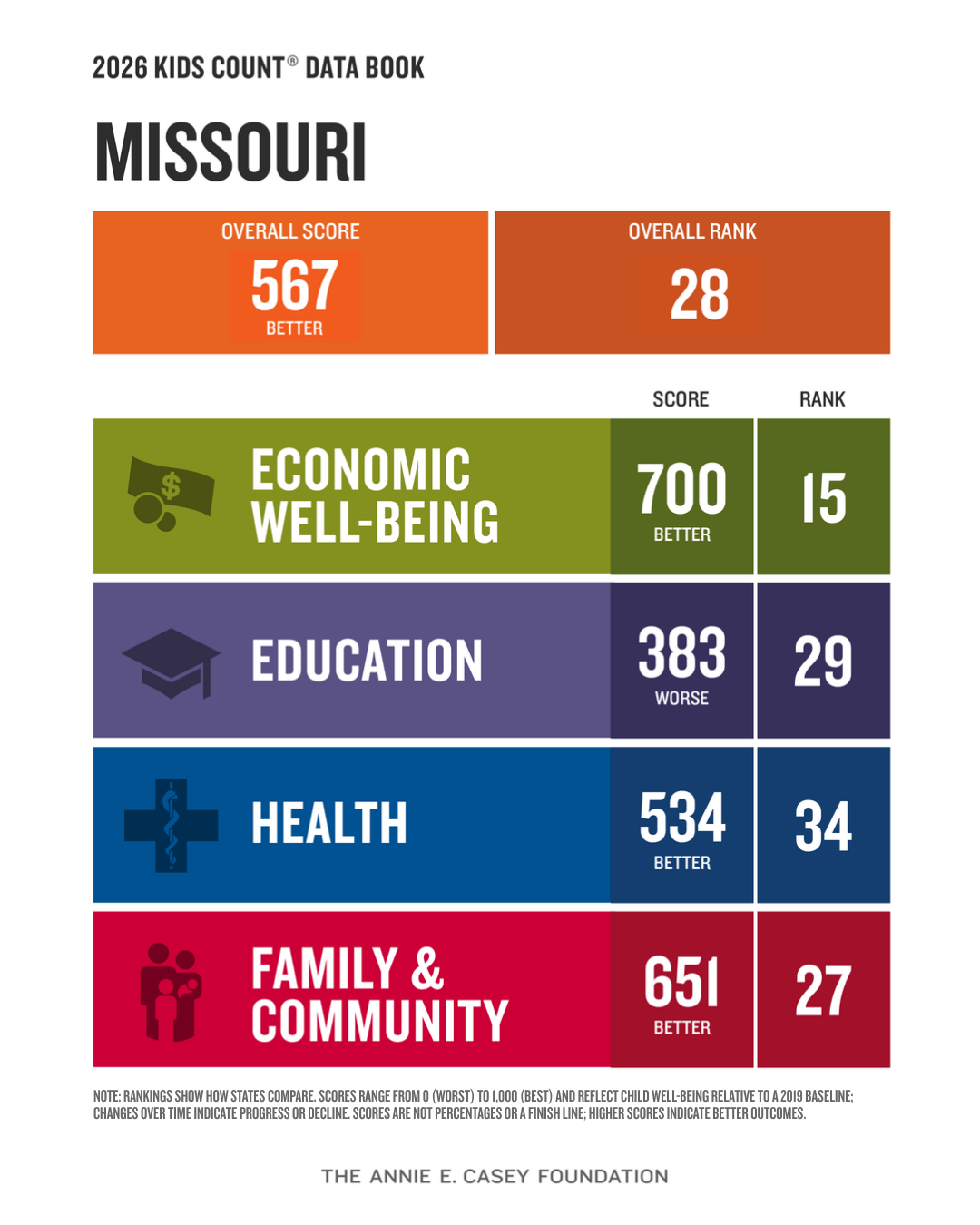
Education presents the most alarming trend for Missouri’s youth, particularly regarding foundational academic skills. Standardized testing performance shows a sharp decline, with fourth graders who are not proficient in reading climbing from 66% to 73%. Similarly, eighth graders lacking proficiency in math spiked from 68% to 77%. Despite these heavy academic setbacks in earlier grades, high school graduation metrics offer a bright spot, with the state’s overall graduation rate rising to 92.1% by 2024.
Health and community outcomes also paint a complicated picture of development. On the positive side, teen birth rates dropped from 20 to 16 per 1,000, and the percentage of overweight or obese youth decreased from 34% to 30%. Conversely, the child and teen death rate rose from 32 to 34 per 100,000, indicating growing safety concerns. Ultimately, while Missouri’s children benefit from better job security for their parents, substantial work remains to recover lost academic ground and ensure physical safety.
Summary of the New KIDS COUNT Index Methodology
The Annie E. Casey Foundation updated how it calculates its KIDS COUNT Index to better track the well-being of children across the United States. The index evaluates four key areas: economic well-being, education, health, and family and community factors. [1, 2]
What’s New — And Why It Matters
- State Scores: The index now assigns a score from 0 to 1,000 to each state alongside traditional rankings.
- Pandemic Baseline: Progress is tracked using 2019 data as a baseline to measure the true impact of the pandemic.
- Better Accuracy: Scores reveal actual progress or decline, whereas rankings only show how states compare to each other. [1, 2, 3]
How the Updated Methodology Works
- 16 Indicators: The index still monitors 16 specific data points across the four main domains.
- New Scaling: Data is standardized using a minimum-to-maximum transformation instead of the old z-score system.
- Equal Weighting: Every indicator is weighted equally when calculated into the final domain and overall scores. [1, 2, 3]